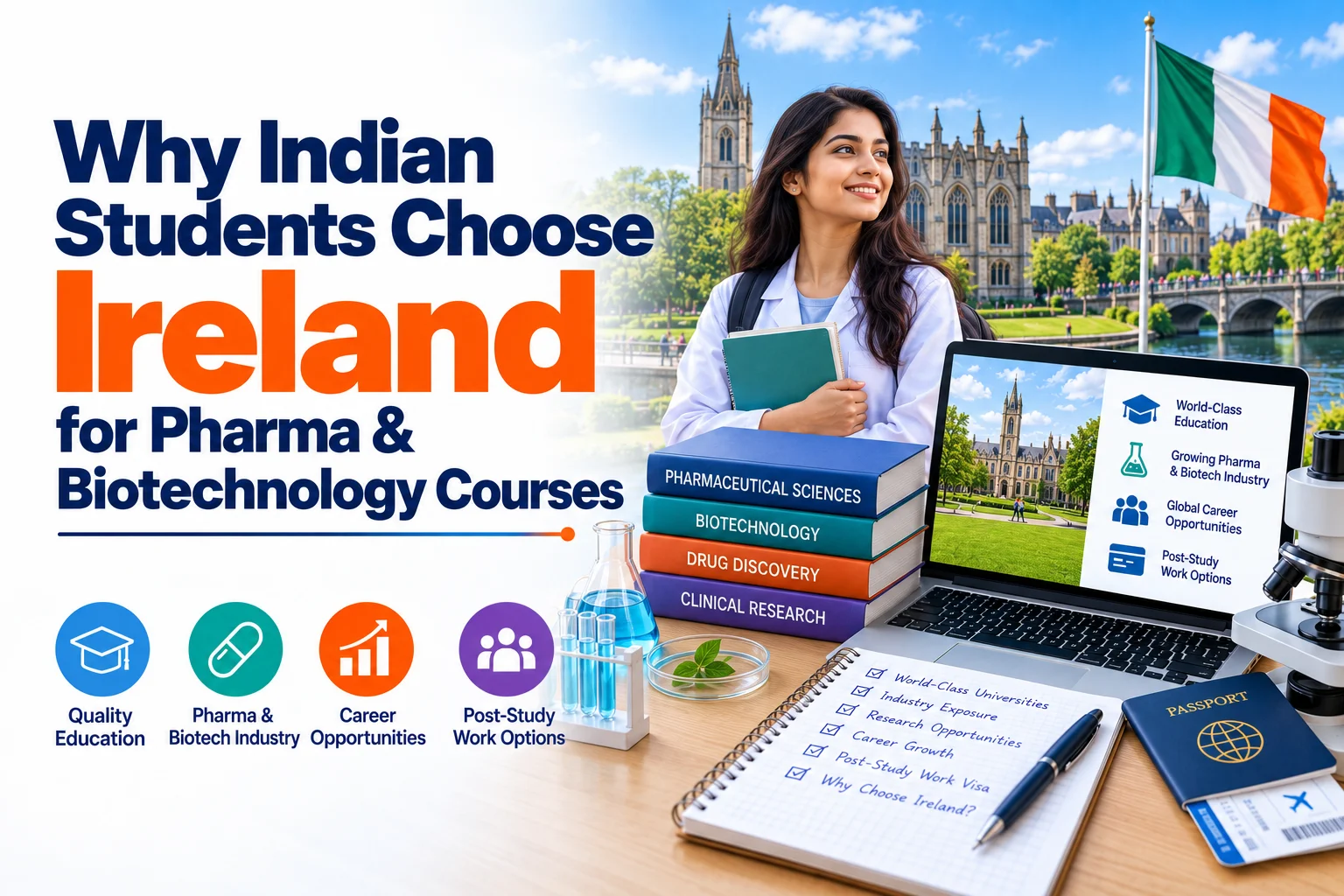
Ireland has become a leading destination for pharmaceutical and biotechnology education. As the world’s third-largest pharmaceutical exporter and home to many of the world’s top pharma companies, it offers students a rare mix of academic quality and direct industry access. For Indian students, pharma and biotechnology courses in Ireland combine internationally recognised degrees, hands-on training, and strong career prospects in a fast-growing sector. Add an English-speaking environment and a generous post-study work route, and it becomes clear why Ireland is a preferred choice for science and healthcare graduates.
Why Ireland Is a Global Pharma and Biotechnology Hub
Ireland’s reputation in life sciences is built on decades of investment and a dense cluster of global manufacturers.
- Global Leaders: Nine of the world’s top ten pharmaceutical companies operate in Ireland, including Pfizer, Eli Lilly, Johnson & Johnson, Amgen, MSD, and Takeda.
- Major Exports: Pharmaceuticals make up a large share of Irish exports, placing the sector at the centre of the economy.
- Regional Clusters: Cork specialises in active-ingredient manufacturing, while Dublin is a growing centre for biologics and biotechnology.
- World-Class Training: The National Institute for Bioprocessing Research and Training (NIBRT), based on the UCD campus, offers hands-on bioprocessing facilities used across several master’s programmes.
This concentration of companies and research centres gives students direct exposure to industry during and after their studies. The sector employs tens of thousands of people and continues to attract new investment in biologics and advanced therapies, keeping demand for skilled graduates high.
Popular Pharma and Biotechnology Courses in Ireland
Irish universities and technological universities offer a wide range of pharmaceutical and biotechnology courses, mostly at master’s level and usually completed in one year.
- MSc Biotechnology: Covers molecular biology, genetic engineering, bioprocessing, and bioinformatics.
- MSc Pharmaceutical Science / Manufacturing: Focuses on drug development, formulation, and quality systems.
- MSc Biopharmaceutical Science / Bioprocessing: Industry-focused, often with practical training at NIBRT.
- MSc Regulatory Affairs and Quality Assurance: Prepares graduates for compliance roles in regulated environments.
Leading institutions include University College Dublin, Trinity College Dublin, University College Cork, University of Galway, the University of Limerick, RCSI, and Dublin City University. Most programmes start in September, with some offering January entry, and many include lab work, industry projects, or placements. At NewStrides Consulting Pvt Ltd, we assess your academic background and career goals to shortlist the pharma or biotechnology programme and university that best match your profile and budget.
Eligibility for Indian Students
Entry requirements vary by course and institution, but most master’s programmes look for a relevant science background.
- Academic Background: A bachelor’s degree in biotechnology, life sciences, biomedical science, microbiology, pharmacy, chemistry, or a related field.
- Academic Performance: A strong percentage or CGPA, with the exact threshold set by each university.
- English Language: IELTS 6.5 overall with no band below 6.0 is a common requirement, though some courses ask for higher scores.
- Documents: A statement of purpose, academic transcripts, and letters of recommendation. Relevant laboratory or internship experience is an advantage.
These requirements can help students assess their eligibility and prepare the necessary documents before applying to suitable programmes.
Fees and Cost of Studying in Ireland
For Indian students, the cost of studying in Ireland covers tuition and living expenses. Pharma and biotechnology master’s fees are charged per year and vary by university.
| Cost Factor | Approximate Amount (Non-EU) |
| Master’s tuition (per year) | €15,000 – €30,000, depending on the university |
| Living costs (per month) | €1,000 – €1,500, higher in Dublin |
| Proof of funds (student visa) | Around €10,000 for the first year |
Several universities offer scholarships for international students. We help students identify suitable scholarships and arrange education loans and foreign remittance, making the overall cost easier to plan.
Career Opportunities in Pharma and Biotechnology
Pharmaceutical and biotechnology careers in Ireland offer opportunities across pharma, biotech, medical technology, diagnostics, and cell and gene therapy.
- Career Roles: Graduates can work as process scientists, quality control analysts, validation engineers, regulatory affairs officers, and research associates.
- Major Employers: Pfizer, MSD, Eli Lilly, Amgen, Janssen, and Takeda are among the sector’s employers.
- Salary Prospects: Starting salaries are often around €40,000 or more, depending on the role and employer.
- Work Opportunities: Many relevant roles appear on Ireland’s Critical Skills Occupations List, supporting longer-term work permit options.
- Post-Study Work: Under the Third Level Graduate Programme (Stamp 1G), master’s graduates can stay in Ireland for up to 24 months to seek and take up employment.
- Visa Support: At NewStrides Consulting Pvt Ltd, our visa team helps students prepare proof of funds and other documentation correctly, backed by a visa rejection rate of less than 0.1%.
These career pathways make Ireland a strong option for graduates seeking opportunities in pharma, biotechnology, and related life science industries.
Conclusion
For Indian students aiming at a career in life sciences, Ireland offers a rare combination of academic strength and industry access. Its position as a global pharma and biotechnology hub, hands-on training facilities such as NIBRT, and a generous post-study work route make it a practical choice for building an international career. Before applying, compare course content, eligibility, fees, and career outcomes across universities to find the right fit. With careful planning around intakes, funding, and the visa process, a pharma or biotechnology degree in Ireland can be a strong long-term investment.
FAQs
Which pharma and biotechnology courses are popular in Ireland?
MSc programmes in Biotechnology, Pharmaceutical Science, Biopharmaceutical Science, Bioprocessing, and Regulatory Affairs are among the most popular.
What are the fees for pharma and biotechnology courses in Ireland?
Master’s tuition for non-EU students generally ranges from about €15,000 to €30,000 per year, plus living costs.
What qualifications do Indian students need?
A relevant bachelor’s degree in a science or related field and an IELTS score of 6.5 overall (no band below 6.0) are commonly required.
Can Indian students work in Ireland after these courses?
Master’s graduates can stay up to 24 months under the Stamp 1G route, and many pharma and biotech roles are on the Critical Skills list.

With over 10 years of experience, Sonali Deshmukh is recognized as one of the best in the education counselling industry. She specializes in helping students secure admissions in Ireland and the UK, offering clear, practical guidance throughout the process. Known for her straightforward approach, Sonali ensures every student receives honest advice and a well-defined pathway to success.